 |
| |
 |
| |
 |
| |
 |
| |
 |
| |
 |
| |
 |
| |
 |
Why Occupational Therapy?
WHY OCCUPATIONAL THERAPY?
Adolescents subjected to gang activity in their community are often deprived of
productive occupations. Occupations are defined as activities that "occupy" your time
which are both meaningful and purposeful (Christensen, Clark, Keilhofner, & Rogers,
1995). The engagement of occupation is a fundamental part of human development,
life satisfaction, personal growth, and health (Hemmingson, H. & Jonsson, H., 2005).
An individual’s decision to engage in a particular occupation may be dependent on a
number of contextual factors which include personal, institutional, social, cultural,
temporal, and environmental. Additionally, an individual’s ability to perceive, organize,
and adapt to the contextual factors is dependent on intrinsic issues such as
biophysical, cognitive, and temporal factors.
Structured activities and goal setting have been identified as effective program
practices. Group and individual life skills activities include anger management, anti-
bullying, time management, academic preparation, self-esteem building, or other
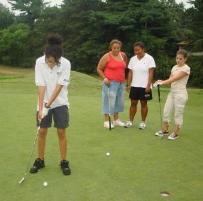
skills fundamental to adult success and the acquisition of healthy occupations. Golf is
used as a medium for developing essential life skills. The group activities are not held
in a medical institution or residence , but on a golf course, driving range, or college
campus. These activities provide positive experiences consistent with their personal
values, strengths and developmental readiness. Through golf play and social
interaction, at-risk youths gain confidence in “doing.” Through the use of structured
purposeful and meaningful activities, youths and mentors gain a sense of self and
program efficacy.
Adolescents subjected to gang activity in their community are often deprived of
productive occupations. Occupations are defined as activities that "occupy" your time
which are both meaningful and purposeful (Christensen, Clark, Keilhofner, & Rogers,
1995). The engagement of occupation is a fundamental part of human development,
life satisfaction, personal growth, and health (Hemmingson, H. & Jonsson, H., 2005).
An individual’s decision to engage in a particular occupation may be dependent on a
number of contextual factors which include personal, institutional, social, cultural,
temporal, and environmental. Additionally, an individual’s ability to perceive, organize,
and adapt to the contextual factors is dependent on intrinsic issues such as
biophysical, cognitive, and temporal factors.
Structured activities and goal setting have been identified as effective program
practices. Group and individual life skills activities include anger management, anti-
bullying, time management, academic preparation, self-esteem building, or other
skills fundamental to adult success and the acquisition of healthy occupations. Golf is
used as a medium for developing essential life skills. The group activities are not held
in a medical institution or residence , but on a golf course, driving range, or college
campus. These activities provide positive experiences consistent with their personal
values, strengths and developmental readiness. Through golf play and social
interaction, at-risk youths gain confidence in “doing.” Through the use of structured
purposeful and meaningful activities, youths and mentors gain a sense of self and
program efficacy.